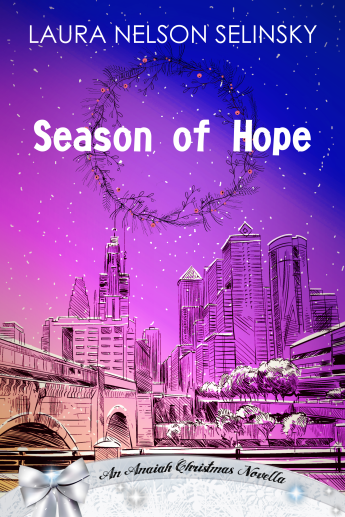
{From Gemma: I am deeply pleased to welcome my friend and colleague Laura Nelson Selinskyas a guest on my blog to celebrate the release day of her new novella, Season of Hope. Please read on for Laura’s post.}
Release Day Nov. 1 2019
If you are a reader of a certain age, your childhood included “paint by numbers,” an allegedly artistic activity. It was the sort of gift you received at Christmas from childless and unimaginative relations. Paint by numbers sets attempted to quantify beauty and force it into the chubby fingers of eight-year olds. At best, painting by numbers represented a quixotic and foolish quest.
As a fantasy writer, I do love a foolish quest. Today, I’m on a quest to quantify my writing by numbers, starting with zero.
Zero: For much of my life, I wasn’t a fiction writer. That doesn’t mean I didn’t write, but that my writing wasn’t a passionate creative process. In college and seminary, I wrote essays, analyses, and research. As a pastor and ministry leader, I wrote sermons, scripts, and curriculum. For teaching, I wrote reports, emails, and even a few letters. But I wrote zero words of fiction from the day I graduated from grammar school to the day I turned fifty.
Fifty: On my fiftieth birthday, I started a novel. A host of fictional people live in my head, and I wanted to let them out to play. Two months later, I had completed a draft of the still unpublished Daughter of Fire. By the time I was fifty-two, another novel was complete. I began to write query letters, seeking print homes for my books.
300,000: The next decade of writing meant watching my wordcount tick toward the stratosphere. 300,000 is roughly the number of words in AGame of Thrones or Bleak House, depending on how classy you like your wordcounts. And that’s only if I think of each story as a single draft. Some of my projects have been through five drafts; one has been revised nine times. If I consider the number of words deleted, supplemented, or revised? Yikes, that’s a lot of writing. 300,000 is easier to imagine.
Ten: By my sixtieth birthday, I had published a couple of short stories and a nonfiction piece about teaching students with learning differences. My birthday gift was an email from the wonderful editor Kara Leigh Miller, saying that she was taking my Christmas novella before the purchasing committee at Anaiah Press. I had sold Season of Hope by the end of the following week—ten years after I began writing seriously. Through Kara’s editorial guidance Season of Hope grew to 50,000 words, treading the line between an overgrown novella and a wee little novel. Ten is also the number of years that I have spent in a priceless critique group sponsored by Pennwriters and marshalled by Gemma Brook, mistress of this blog.
One: Season of Hope is being released today, November 1, 2019. It will be followed in ten days by Beach Dreams. I entered my first writing competition this summer, and my short story Shells won second place. That story, a meditation on the ways we measure the children we love, will be featured in Beach Dreams, published by Cat and Mouse Press.
Release Day Nov 10 2019
Winning a writing contest in one try seems absurdly, undeservedly easy if you ignore ten and 300,000. But writers aren’t paint by numbers automatons. If you want to write, ten and 300,000, and the perseverance they represent, are the only numbers that matter.
From Gemma: Thank you for sharing a bit of your writing history, Laura, and the inspiring perseverance encapsulated within. Congratulations on the excellent news of your imminent publications! I invite my readers to connect with you through these links for Facebookand Twitteror by searching Laura Nelson Selinsky. Readers, you can also find Laura on her Amazon page. And you can meet her in person at the Beach Dreams launch party! If you can’t make the party, you can read newinterviewswith Laura by Melinda Dozier, by Sara Beth Williams, and at Batya’s Bits.
I have exciting news – my next publication is coming out soon! My fiction is included in Running Wild Anthology of Stories Vol. 3, due on or around Sept. 15th, 2019. My contribution is a bit of flash fiction, “The One that Got Away,” which won an award at a recent Pennwriters Conference. It’s about a bunch of fisherman swapping stories and the tale that tops them all.
My story joins Aud Supplee’s “Monkey in the Middle.” I’ve read a lot of Aud’s fine fiction, but not this one and I’m excited to read it.
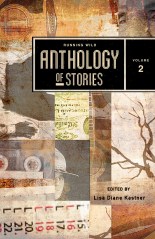
This collection is a follow-up to Running Wild Anthologyof Stories Vol. 2, which features two of my pieces. That collection is packed with excellent stories; you can read interviews with several of the authors (and others) on my site.
Volume Two
I can’t wait to see what Volume 3 holds! Check back for updates and the cover reveal.
Meanwhile, I’ll be hard at work on my fantasy novel.
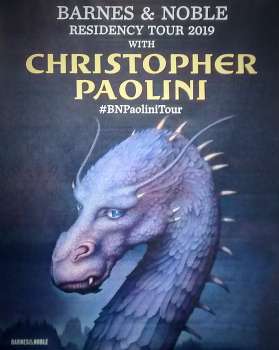
Barnes & Noble is hosting an Author Residency Book Tour with Christopher Paolini over the coming months. And from what I’ve seen of it, it’s a lot of fun! The staff at the B&N bookstore I went to made it a great, smooth-running event. Kudos to them.
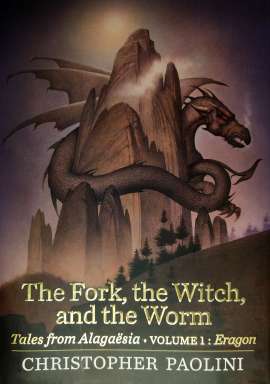
Now I confess I haven’t read the books (so many books, so little time! I’m a slow reader, and thick books can be daunting). But a dear friend who is an avid and discerning reader has enjoyed them, and that was good enough for me to think about getting the latest book, The Fork, The Witch, and the Worm, for my great-nephew who likes mythology and fantasy.
My copy…for now
The Residency Tour is in only about a dozen cities, so I’m quite pleased that the only mid-Atlantic location was in my state! And dragons, like most mythical beasts, are dear to my heart. So I decided to go. My friend Aud Supplee also came, bringing another friend. And Aud has also written a blog about her perspective of the event, so check that out!
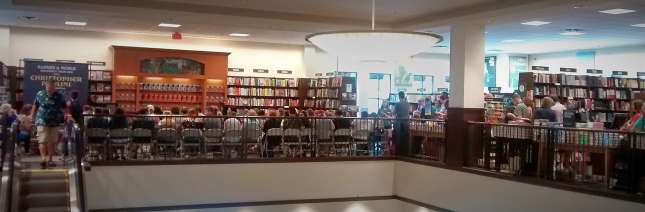
The Waiting Crowd
My first impression of Christopher Paolini was how warm and unassuming he was, and genuinely delighted to be there. (A friend who works at the store and helped organize the event says he was great to talk to and super-nice behind the scenes, too.) He was content to blend in with the crowd while we were playing trivia with the B&N booksellers. One of the questions was something like, “What did Eragon get from his sister?” Christopher jovially called from the crowd, “More questions!” (Please forgive me, fans – you’ll probably know exactly what that question was, and if it wasn’t about his sister, I apologize! I can only plead ignorance and faulty memory; I wasn’t taking notes.)
Then Christopher took the mike to talk to us. He honestly seemed to enjoy it as much as the audience did.
Christopher Presenting
With self-deprecating humor, he said, “Some of you may have noticed that it’s been awhile since my last book.” We all laughed. He explained how he started Eragon when he was 15, (1998), and he was still touring with the fourth book in 2012 – a huge chunk of his young life. When he was done he wanted nothing to do with dragons for awhile! Meanwhile, he’s been writing a big sci-fi book “with tentacles.” But he would wonder at odd moments, “What are Eragon and Saphira doing now?” Then he wondered what it would be like to write about a very old, angry, hungry dragon. “Like Smaug,” I think someone in the audience said. “Or like the dragon in Beowulf,” Christopher said. That formed the basis of the “Worm” story in his new book.
A fan once tweeted him, “What’s Murtagh doing?” Because Christopher was awake at 1:00 a.m. from too much coffee and feeling kind of snarky, he answered, “Fighting off foes with a magic fork named Mr. Stabby.” But then he wondered, Could I write a story like that? That, of course, became “The Fork” in the new collection.
His sister Angela had an idea for a story, and he told her to go for it. That became “On the Nature of Stars,” part of “The Witch.” As Christopher sat down to write the story that weaves together all these tales, he felt like he was returning home after a long journey. “Why did I wait so long?” The audience cheered.
Speaking more about inspiration, he talked about how a certain disappointing blockbuster movie made him think – how could I fix that? Human beings are born storytellers, he says – we know when a story doesn’t work. He talked at length at how flawed writing can inspire a writer more than perfect writing does – as you think about how you could fix things.
As a young boy, he was inspired by a book he loved, Jeremy Thatcher, Dragon Hatcher by Bruce Coville, about a boy who finds a dragon egg. It made him think about what kind of world a dragon would come from, which led to more questions. That’s how we write stories and build worlds, he said – asking questions and answering them as honestly as we can.
Then Christopher engaged briefly in a bit of what he called “shameless self-promotion.” His mother is a homeschooler, and she has published books to help others; he hoped any home-schoolers in the audience would check them out. Also, he mentioned the recent Barnes & Noble Exclusive Collector’s Edition of Eragon. It has a full-color map, (I love book maps), and under the dustcover is the insignia of Brom’s ring, designed by Christopher himself. Pretty cool! Though of course that’s promoting his first book, it’s also supporting Barnes & Noble, his hosts, and like all bricks-and-mortar bookstores they can use all such support. Pretty gracious “self-promotion” if you ask me!
He confirmed (to much audience excitement) that there is a fifth Inheritance book in the works, which will answer a lot of questions. Then the audience asked fun questions, like what fantasy would he like to insert Eragon into. “Does Hunger Games count as fantasy?” His favorite movies? He has so many, including “Pan’s Labyrinth,” “Terminator” and “The Little Princess (1995)”. Yep, an odd juxtaposition, that! Some of his many favorite books include The Worm Ouroboros, by E.R. Eddison, pre-Tolkien fantasy of Tolkien caliber, and Gormenghast, by Mervyn Peak, the gothiest book ever, according to Christopher.
When someone asked what he wished he’d known about publishing at the start, he answered: mistakes are part of the process. A bad sentence, paragraph, even a bad draft doesn’t mean you’re a bad writer. When something makes you uncomfortable, the things you know you’re not good at, push into them. That’s what will make you grow as a writer, and a person.
He read a little from all four books, including an Elven blessing, (he claims he has an awful Elven accent) and something from a very angry Dwarf (he says he has an excellent dwarf accent, because he trills his rrrs with his uvula!) When he read from “The Worm,” (in normal English), it struck me it had a fine, old-epic tone.
Then it was time for the book signing. Even waiting and standing in line was fun – we got to talk to very friendly fans (who didn’t seem to mind my ignorance). Christopher took time to talk to everyone who came up. He was as warm and friendly up close as he was from a distance. And early-comers got a cool Inheritance pin, compliments of Barnes & Noble.
B & N’s gift for early comers
Thank you, Barnes & Noble, for hosting such a fun event. Readers, if you’ve enjoyed the books, check out his tour and see if he’s coming anywhere near you.
And thank you, Christopher Paolini. You’ve made me a fan! Even though I bought the book as a gift, and I really shouldn’t, I might just have to peek inside for a read…
It’s my great pleasure to welcome Alexandra Coulter to my blog. Alexandra has been in a critique group with Aud Supplee and me for many years.
Welcome, Alexandra!
Tell me a bit about your writing history. When did you realize you wanted to be a writer? And what led to that?
Alexandra: I had written most of my life and always enjoyed it. My earliest memory was of a story about lions I wrote in 3rd grade. I penned several collections of stories about a group of characters in spiral notebooks. From time to time I’d write stories or essays on a topic. However, no one ever said I could be a writer.
Gemma: Was that discouraging? Or was it simply not something that you thought about?Alexandra: I wasn’t discouraged. I wrote because I enjoyed doing it. As the years went by, I did several writing assignments and a few articles for friends and relatives, but it still hadn’t occurred to me that I might be a writer.
Gemma: Wow, even after doing significant writing… So, how did you come to that realization?Alexandra: During a time when I didn’t have to work, faced with many hours alone at home, I knew it was time for me to figure out what I wanted to be when I grew up. I had spent my working career chasing the music business the only way I knew how, through my administrative, typing and organizing skills. A series of unsatisfactory jobs leading up to my semi early retirement left me wondering what to do with myself. Was I going to give up and do nothing, looking for the same old job or make a commitment to become a writer? When it dawned on me that I had already done a lot of writing and I really enjoyed it and found it easy, the decision was made.
Gemma: Excellent! To find something that you enjoy and that comes easily is really a gift.
What came next?
Alexandra: That prompted me to take a writing class, get a lot of library books and learn everything I could about it. Despite a difficult teacher, I produced in that class, writing 2 and a half short stories, while most of the class only managed 1 over the 6 weeks. After a short set back, I came out swinging.
Gemma: Good for you for overcoming that setback. Was it the teacher?
Alexandra: Yes it was. He criticized everything I did, including commenting on knowledge he didn’t have, on the content. The rest of the class liked what I did. So, I eventually realized he was a jerk and that shouldn’t stop me from moving toward becoming a writer.
Gemma: Excellent. That’s not an easy realization to come to. Where did you go from there?
Alexandra: I had read somewhere that you can call yourself a writer when you’ve written 100,000 words. I was determined to do it! I remember the day I realized I’d reached that point. When I had reduced the number of words in my novel from 180,000 to 100,000. I figured I must have written much more than 100,000 words, maybe pushing 300 or 400,000! That was the moment I felt I could call myself a writer.
Gemma: I had never heard that definition – but that’s an excellent goal to achieve. And it’s quite cool that you came to it not by struggling to reach that number, but by cutting down to it.
Gemma: Tell me a bit more about your writing history.
Alexandra: My first published writing came in college where I maintained a monthly column called “Stick this in Your Ear,” which featured my thoughts on contemporary music and local musicians. I had been writing love stories and essays. And even a few pieces for local small-town publications. From the first writing class, I developed my stories into novels and worked with them. The first novel, The Easy Road, was published on Amazon as an e-book in 2012.
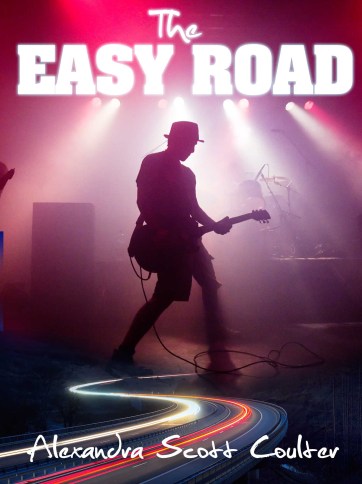
The Easy Road by Alexandra Coulter
Alexandra: When I found myself out of work again, I decided to give professional freelance writing a try. I had moderate and sporadic success which had me running back to the safety of a “real” job time and time again. I gave up the idea of freelance writing in 2014 and have never looked back. I continue to play with my second novel and am developing a book for teenage girls, through my critique group, that I hope to publish in the next few years. Writing continues to be a practice for me, striving for 3 pages a day and 10 pages a month.
Gemma: 10 pages a month is my goal, too – perhaps not coincidentally the page limit for our critique group!
Gemma: what’s the first piece you wrote that you’re still proud of?
Alexandra: I think the initial short story of Easy Road was maybe my first truly organized and me-inspired work I’d done. For the class I wrote a sci-fi story that I do still like, but The Easy Road has come to be a much bigger piece of work and more integral to my growth as a writer. I haven’t read it in a long time, but I feel proud of putting it together and publishing it.
Gemma: that really is an accomplishment! Tell a little of what it’s about.
Alexandra: It’s about a 30-something accountant with aging parents, a girlfriend and an impending partnership in the accounting firm who’s offered a record deal. He struggles with taking what he always thought of as the easy road of sex, drugs and rock n’ roll.
Gemma: I’ve read drafts of that novel in our critique group, and it was quite a ride! It’s so satisfying that now it’s a book.
Gemma: What do you feel is your mission as a writer?
Alexandra: My mission has always been to say what I feel compelled to say. I wish to be a conduit for words. I believe I have stories to tell and messages to communicate. I’m not sure I can say what writing means to me. It’s always been my solace. I have been journaling steadily for many, many years now. It has allowed me to find my voice and my inner core, to learn more about myself and how I tick. Writing has allowed me to express the visions in my head. Written words have, at times, allowed me to express thoughts and feelings I couldn’t any other way.
Gemma: So much of that rings true for me, and I bet it resonates with many other writers, too.
Gemma: What’s the hardest part of writing for you?
Alexandra: Well, that has changed over the years. I think, these days, the hardest part is finding the time and energy to give to it.
Gemma: What’s the part of writing you like best?
Alexandra: I’d like to say that it is when I get it right on paper. When I say exactly what it is I wanted to say. That is a wonderful part of it. But I also really like praise. When someone appreciates what I’ve said to them. That I have somehow eased or lightened their burden, lifted their hearts, opened their eyes.
Gemma: That’s the most wonderful kind of feedback, I think. Your writing has certainly opened my eyes in some new ways!
Gemma: What kind of experiences have most influenced your writing?
Alexandra: My experiences in the music business have certainly had an influence on my fiction writings. I find what inspires me more than anything is live music. Live performances. I do like to write with music on. I am quite sure that influences me on many levels. My other impactful influences are other people and their words.
Gemma: And your writing often has music and musicians in it – that influence really shines through.
Gemma: What other kinds of things have an effect on your writing?
Alexandra: Maybe movies like Help and Spinal Tap had an effect on my writing. Certainly, it was the people I met. As for my non-fiction writing, I have been influenced by Susan Jeffers, SARK, Marianne Williamson, and Libby Gill. Writing teachers Brenda Ueland, Natalie Goldberg, and Anne Lamott. I’d have to say too, that I have been heavily influenced by my writer’s group who have kept me committed, guided me back to the path and showed me a new way month by month.
Gemma: Me, too, Alexandra, me too!
Gemma: What kind of things do you read?
Alexandra: I don’t have a lot of time to read these days. Most of what I read are my colleagues’ work. I read selected works of the spiritual authors I most like and I read health and healthy eating publications.
Gemma: I’m touched and honored our pieces are a lot of what you read – but also sad you don’t have time for more!
Gemma: What are you reading presently?
Alexandra: I am reading Ask and it is Given by Esther and Jerry Hicks. An Abraham book. There are quite a few business books in my stack and I always have an inspirational writing book. At the moment it’s If You Want to Write by Brenda Ueland.
Gemma: I’m glad you take time to read these!
Gemma: What are you working on now?
Alexandra: My focus continues to be How to Create an Awesome Life – A curriculum for girls. A book of classes for girls 14 to 18 to help them find themselves and build lives they can love. I am working on 2-pages per day writing practice on a topic and trying to complete an essay every month (or 2). I am also working on developing my writing at work to be able to grow my career.
Gemma: What is the next project you hope to work on?
Alexandra: I have a good draft of my second novel, Lucky Day. When I complete the Awesome Life, I hope to do a final draft of the novel.
Gemma: Tell us a little bit about Lucky Day.
Alexandra: This one is about a girl drummer who dreams of recording her songs, but her bad luck continually keeps her from realizing her dream.
Gemma: I’ve read that in its earlier drafts, and I’d love to see it published.
Alexandra: My first novel, The Easy Road, will be published as a physical book this year.
Gemma: that’s very cool!
Alexandra: And I want to work on my publishing company, UpWrite Words, including a physical book from author Paulette Terrels-Clarke. Other projects bubbling under the surface are to revive my blog and develop some of the material I have in my files.
Gemma: that sounds like a lot of great projects to look forward to.
Gemma: Readers, check out the e-book of The Easy Road here. And be sure to check back for Alexandra’s future projects.
Alexandra: Thanks, Gemma, for talking with me. It’s been a real pleasure!
Gemma: The pleasure is mutual! Thanks for being part of my blog, and part of our critique group!
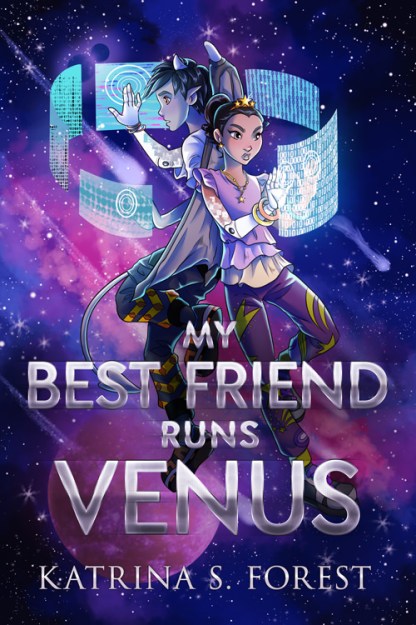
I’m delighted to welcome Katrina S. Forest to my blog. Katrina and I have been in the same critique group for many years, along with Laura Selinsky and others, and Katrina is the first of us to release a novel! It’s a very cool-sounding middle grade sci-fi called My Best Friend Runs Venus.
cover by Crystal Rose
You can buy it from Amazon, Barnes & Noble, or Katrina’s site, or order it from your local bookstore. I ordered a copy from my local Barnes & Noble – I got Free Shipping to my home and it arrived in only about 2 ½ days. (It looks even more cool in person – so cool, in fact, I ordered another copy from my local indie bookshop for my great niece!)
To celebrate this great news, I’m taking part in a blog tour for Katrina’s book; the tour runs until June 16th. This blog tour is hosted by Lola’s Blog Tours. You can see the full tour schedule here.
Be sure to get to the bottom of this post, as there’s a tour-wide giveaway for the blog tour. One winner will win a signed copy of My Best Friend Runs Venus along with a $25 Amazon gift card.
Here’s what the book is about:
“At 12.9 years old, number-obsessed Kade Walker has never heard of death. Literally. But neither has anyone else he knows. Kade is one of hundreds of kids “living” across the solar system through robotic avatars while their real bodies sleep in pods on Earth. Unfortunately, robot bodies can be hacked.
One day during an (innocent!) experiment, Kade unwittingly breaks a major security wall and releases an infamous hacker. The madwoman targets all the royal avatars, including Kade’s best friend, Princess Tamika of Venus.
If Kade and Tamika don’t want to become the hacker’s puppets, they’ve got to stop her fast–even if it means waking up on Earth to fight with bodies they never realized could be hurt.
Kade and Tamika illustration by Crystal Rose
Sidebar: after a quick peek inside, now I know why Kade looks the way he does – I think.
Welcome, Katrina! What a fun story this sounds like. Can you tell us something (non-spoilery!) about what first gave you the idea for it?
Katrina: It started with me trying to take a fantasy-based idea I saw on an old TV show and imagine how it could conceivably work as a science fiction setting. The show’s premise was that a group of teens were secretly interstellar royalty and drew magic powers from their respective planets. I think a lot of sci-fi starts with the “what ifs.” So in this case it was, “What if we could live comfortably on other planets without magic (or magic-like levels of terraforming)?” “What if we had kids and teenagers in charge?” and more importantly, “Why would we do that?” I came up with the concept of the robot avatars allowing people to live across the solar system. And since kids are much more adaptive to new technology, they’re the only ones that can use it 24/7. Hence, they’re in charge. The characters who would inhabit this world were then developed, which is actually the complete opposite of my usual brainstorming process.
Gemma: I love the thinking behind this! Tell me a little more about one of the characters. For instance, which of them would make the best friend?
Katrina: Princess Lorelei of Mercury would make a great friend, as long as you can understand her unique way of talking. (She’s trying to create a simplified language and throws a lot of invented words into her speech.) She’s very open and accepting and tends to see the good in people. She’s also a creative type, and let’s face it, they’re awesome. 🙂
Gemma: oh, she sounds like a lot of fun!
Lorelei illustration by Crystal Rose
Gemma: I’d like to know a bit about your writing past. What’s the first story you remember writing?
Katrina: The first story I ever wrote was called “The Prettiest Flower.” I think I was five. Old enough to sound out simple words but young enough to go pester my mom for spelling helping every two minutes. I guess technically it was a non-fiction piece and included such impressive insights as, “Flowers are pretty” and “Bees like flowers.” I stapled together pieces of construction paper with only a mild attempt to straighten them out first, and my cover was an extra-wide sheet of paper from a dot matrix printer. I knew that “real” books had logos of some kind on the back of them, and because I was making a “real” book, mine got one, too. It was the Chiquita banana logo. I took the sticker from the fruit basket. My mom still has this book, and a few years ago, she showed it to me. It was a totally surreal experience. ^_^
Gemma: I love this! And it’s awesome your mom kept it to show you. When did you realize – or decide – that you wanted to be a writer?
Katrina: Pretty early. My mom got me a school memories book when I entered kindergarten. Every year had the question “What do you want to be when you grow up?” (It changed to, “What do you hope to do after graduation?” for 8th grade and up.) Every year, without fail, I wrote “writer” or “author.” In kindergarten, apparently, I was also open to the possibility of being a ballerina.
Gemma: it’s always good to keep an open mind about such things. And it’s quite impressive that you’ve followed this dream for so long and now have brought it into the world with a novel! What’s the hardest part of writing for you?
Katrina: The hardest part is admitting when I’m stuck. I like to try to push through problems, and sometimes what’s really needed is a quiet step away with a long walk, a cup of tea, or a good book. Or, you know, all those things, because they are all awesome.
Gemma: I totally agree – and those are good ways to get unstuck. What’s the best part for you?
Katrina: The moment of breaking through the aforementioned stuck-ness.
Gemma: yes – that’s a wonderful moment! I think many writers can relate.
A lot of writers when they start out emulate other writers, consciously or not. Can you think of any authors you emulated?
Katrina: Not specifically, although I’m sure I have subconsciously. I do remember being a kid and writing a line I thought sounded totally awesome and way better than what I normally wrote…only to realize shortly afterward that it was a line from Charlotte’s Web. Apparently I’d read the book so many times, my brain just sort of internalized it. ^_^
Gemma: well, that’s an excellent book to absorb! What are you reading presently?
Katrina: I’m currently reading The Merchant Princess series by Charles Stross. My friends are all reading the Laundry series by the same author, but I just really latched onto the protagonist in this one. She’s a very analytical character who finds herself in what’s essentially a magical portal story. Characters really make or break a novel for me. I’ll sit through the most predictable of plots and the most uninteresting of settings if the characters are good. Thankfully, The Merchant Princess has good characters and an intriguing setting and plot to go with them.
Gemma: that sounds like a great combination, and I know what you mean about good characters. If I don’t like at least one character, I can’t make it through a book.
What are you working on now?
Katrina: I’m finishing up a YA novel called How to be an Immortal. It’s about a gorgon and a vampire forming an unlikely friendship as they try to find the gorgon’s sister and stop a mysterious entity from stealing a bunch of humans’ life energy.
Gemma: I’ve been enjoying reading this in our critique group, and I’m very excited to hear you’re close to finishing it. I can’t wait to read the finished book — and, of course My Best Friend Runs Venus! I think it will make a great summer read.
Thanks so much for joining me on my blog, Katrina – and congratulations on your new novel!







 Gemma L. Brook