Book Review: Aylen Isle by Aud Supplee

Happy Tell a Fairy Tale Day!

After too long a hiatus, it’s time to wake up my dormant blog. And what better way than to celebrate some things I love: fairy tales and Aud Supplee’s books.

I’ve enjoyed observing Tell a Fairy Tale Day for several years ( 2019, 2020, 2021, 2022, 2023, and 2024), and this year I particularly want to celebrate Aud’s latest book, Aylen Isle.

Aylen Isle isn’t a fairy tale retelling, but it has many fine fairy tale elements: a bewitched princess, conjurers and wizards, tree sprites, a forest with magical perils and healing “mother trees,” and an enchanted sword with a quite unusual origin (a stone enters into it, but not in the way you might think). All this in the refreshing twist of a tropical island!

Best of all, Aylen Isle centers on some of my favorite fictional young people: Winnie, semi-reluctant heroine on more than one world; her adorable little stepbrother Mikey (who knows something about magic and multiple worlds); and their friend Kip, aspiring magician. They all have important roles in helping the bewitched princess and preventing their nemesis from bringing trouble to the kingdom of Aylen Isle—or any other world, for that matter. And that’s only part of what they have to deal with!

I’m not alone in my love for Aylen Isle. Kirkus Review calls the novel “A gripping adventure enhanced by a creative plot, lively dialogue, and strong female characters.” (If you don’t mind mild spoilers, check out their excellent full review here.)

And the Readers Choice Awards’ 5-star review calls Aylen Isle, “an imaginative and well-crafted novel, which draws readers into a magical world of adventure and self-discovery. With a well-paced plot, timely-twists and turns, and a relatable female protagonist, the book will keep readers engaged until the very end.” (Their full review has mild spoilers, too.)

Aylen Isle is the third book of  Winnie’s, Mikey’s, and Kip’s adventures together. In my opinion, you’ll enjoy this book more if you’ve read at least Hutra, their previous adventure, first. And really, part of the joy is seeing all these young people grow and deepen over time, so why not start with Frama-12, the beginning of it all?

Read more about Aylen Isle (and the whole series) on Aud’s blog.

I recommend Aylen Isle for fantasy lovers from Young Adult to Young at Heart!

Book Review: Hutra by Aud Supplee

Happy National Tell a Fairy Tale Day! In honor of the day, I want to celebrate Hutra by Aud Supplee.

“One lefthanded world. Two missing little boys. Three teens must make it right.”

Hutra isn’t a fairy tale or retelling per se, but it is a fine, fun portal fantasy, part of a series with many fairy tale elements: queens and kings, enchantments, wizards, and knights in shining, er, pink armor with magic swords! Check out Frama-12 (available now) and Aylen Isle (when it’s released) for more about those excellent things.

But you don’t need to have read Frama-12 to enjoy Hutra. Just jump right in, and soon you’ll be plunging through a time tear into another world. You’ll get to know some of my favorite young people: Winnie, avid runner and former reluctant general; her friend Kip, aspiring magician; and her adorable little stepbrother, Mikey, who knows something about generals and magic.

The world they jump into seems like Earth, but something is definitely—off. Make that a lot of somethings. Good thing they have young Nor to help guide them in this new world, though he’s more astonished than they are at their arrival. Nor is an animal communicator, and one of my favorite people in the whole series. As Kirkus Review says, he shines: he’s “privileged but principled, rebellious but deeply affectionate.” Nor may be privileged, but he’s not at all spoiled; in fact, he’s a pretty humble young man, driven by curiosity and a passion for helping animals. Which turns out to be helpful when looking for a lost little boy!

You can meet Nor early in Hutra, and also on Aud’s blog, where she’s posted a deleted scene in honor of Hutra’s “birthday.” I like this scene a lot, and I like the rest of the book even better!

Happy belated birthday, Hutra! And happy reading to all.

Tell a Fairy Tale Day, 2023

Happy National Tell a Fairy Tale Day! I’ve enjoyed blogging in honor of this day for a number of years now, and today I’ll continue that tradition with three notes.

First, a reminder of some Steampunk fairy tales and (at least) one dieselpunk folk tale. Gaslight and Grimm is available now. Grimm Machinations and Greasemonkeys will be available around April 1st and can be pre-ordered now (scroll down past new releases on that page). I’ve read samples of each of the latter two and I’m eagerly awaiting the full anthologies. You can read more about them in my interview with Bernie Mojzes, one of the authors.

Next, Hutra by Aud Supplee is available now: not a fairy tale exactly, but a fine fantasy with animal communication and portals to other worlds – and let’s not forget the “wizard!” I read this book in its infancy, and I’m excited that it’s making its debut. You can read about it on Aud’s blog.

And VT Dorchester’s short story, “Ain’t No Cat” also just came out this month. Though it takes place in the American West, it’s haunted by a creature of Celtic fairy tales: the banshee. I’ve been hearing a bit about this tale for awhile now, and I’m very happy it’s out in print (and pdf). You can read a bit about it on VT’s blog.

Congratulations, Bernie, Aud, and VT!

Of Ice and Faërie

Since today is National Tell a Fairy Tale Day, which I’ve posted about before, this seems an apt day to share some musing about Faërie.

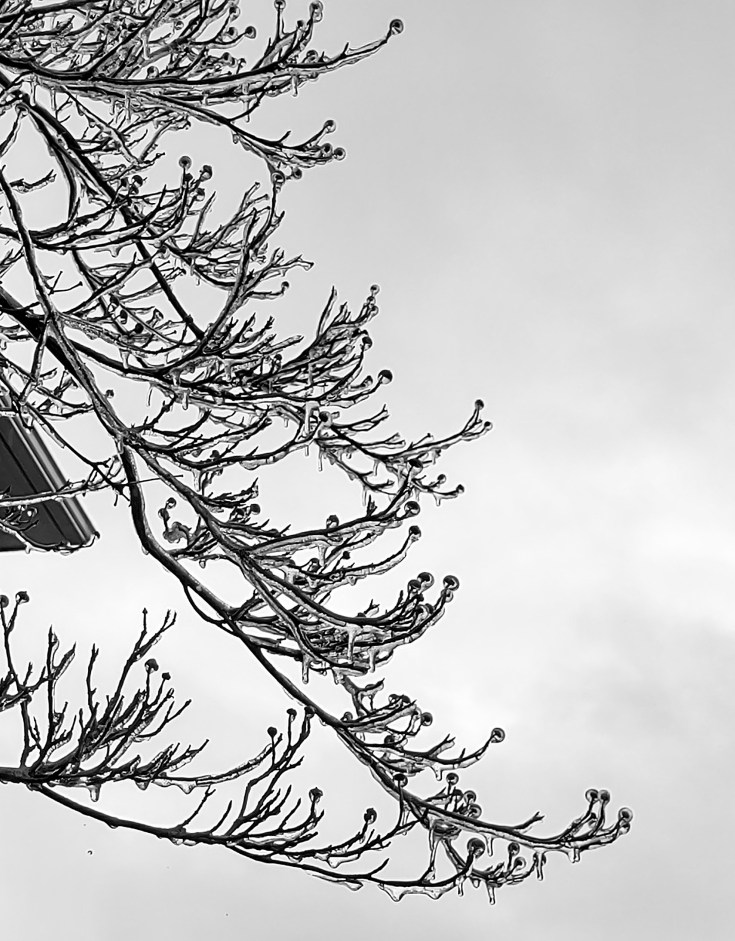
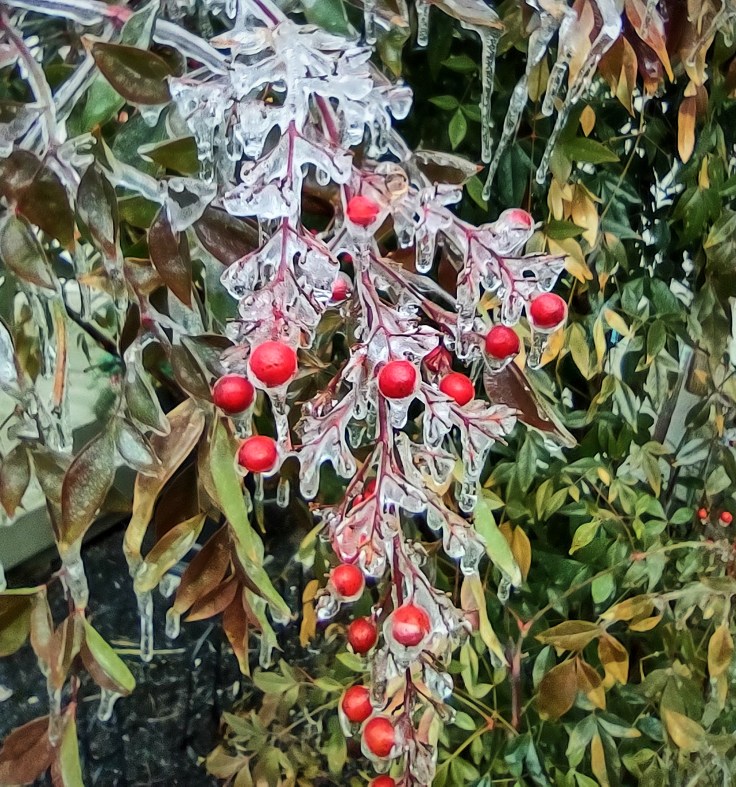
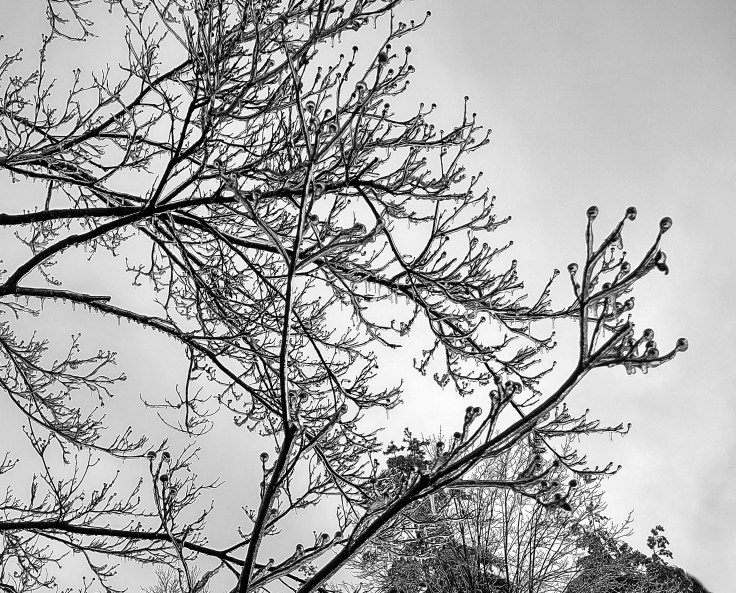
I woke yesterday morning and found all the trees silvered and gleaming with ice against a luminous grey sky. It struck me like a glimpse into the realm of Faërie.

I gazed and marveled and pondered. I think there’s something true about my waking instinct. Where I live, ice storms are unusual. And where I was born and raised, it was a foreign term; I’m not sure I ever encountered one growing up.

To see every tree and bush, every limb and twig limned with translucent silver is magical. It is strange, and beautiful, and rather perilous. And there lies its kinship with the Faërie realm, which can be all those things.

As the morning warmed, pearls of ice dropped from the trees. Then sprays of pearls showered down, and finally the trees shed melting ice in their own rain.

Now our neighborhood is returned to its more earthly form.

I’m left to ponder. The sense that lingers with me is this: what if Faërie is an alternate world, and in rare, near-miraculous moments, what we glimpse is not a view into that world, but rather where that world emerges and merges with our own.

May you enjoy a sojourn into Faërie with a good tale today.

Tell a Fairy Tale Day

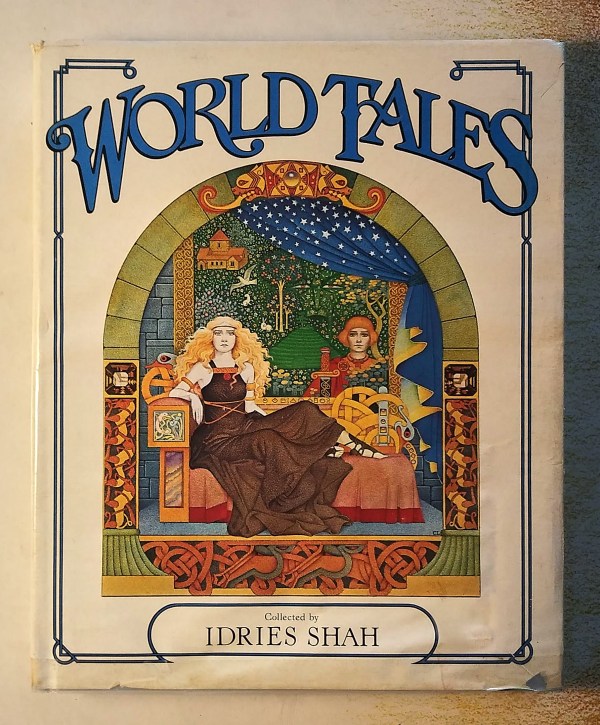
Two days ago, February 26th, was National Tell a Fairy Tale Day. I am a long-time lover of fairy tales, and I’ve blogged in honor of this day twice before. Over the years, I’ve collected a good shelf’s worth of fairy tales,* and I’ve been reading a lot of them lately. One of my favorites is World Tales, in which Idries Shah has collected tales that have been told in many different cultures around the world, with striking parallels. Did you know there are over 300 known variations of Cinderella? I think my favorite is the one in this book, “The Algonquin Cinderella.” As in the well-known tale, the heroine, marred by cinders, suffers from the cruelty of two sisters. But the result of her goodness is much greater than simply marrying a charming prince. Because she can perceive wonders, she becomes the bride of the beautiful and powerful Invisible One.

Reading in my own fairy tale collections over the years, I’ve often felt a shiver of recognition while reading a tale, an echo that this tale reverberates in some other land, some other time. One is the story of “Catherine and Her Fate.” Catherine is given a fateful choice by her Destiny in both World Tales and The Pink Fairy Book (edited by Andrew Lang): she can be happy in her youth or in her old age, but she must choose which.

The shiver of recognition became a thrill of pleasure when I realized some of my favorite stories have been told in many places over many centuries. One is “Mastermaid,” which I found both in World Tales and Tatterhood (edited by Ethel Johnston Phelps).  A good-hearted but rather bumbling young prince is saved from his dangerous naïveté by Maj the Mastermaid. When he forgets her wise advice, they both have trials to go through.

Another tale I love goes by many names and the heroine has many faces: “Clever Manka” in Tatterhood, “The Maiden Wiser than a Tsar” in World Tales, and “The Innkeeper’s Wise Daughter” in Fearless Girls, Wise Women & Beloved Sisters (edited by Kathleen Ragan). The young woman’s wit and wisdom not only saves her father (sometimes his very life), but restores harmony, love and respect to her marriage.

I was excited to stumble upon a much-loved tale twice in my recent reading. It is known as “The Tsaritsa Harpist” in Fearless Girls, and “The Lute Player” in both Tatterhood and The Violet Fairy Book (edited by Andrew Lang). A brave lady seeks to ransom her beloved husband by becoming a wandering minstrel. I feel I have also encountered this as an ancient ballad. This tale echoed in my mind for so long, it turned into a song which came out in a novel I’ve written, where it takes on the yearning for homecoming after long journeys.

These are excellent collections of fairy tales and I deeply enjoyed reading them. But for some stories I have wanted to write a different ending. Like the kind Fisherman who saves the life of a magical, wish-granting flounder, and whose wife demands ever more grandiose and outrageous things. When the wife orders her long-suffering husband to tell the flounder she wants to be Ruler of the Universe, I dearly want the fisherman to say, “No, Wife – I’m done. You tell him if you dare!” In my mind, when the wife gets her comeuppance (very merciful in the old story, I think), the fisherman returns to the humble life he loves, blessed with abundant catches.

And then there is “Kari Woodengown.” Of all the fairy tales I’ve read and heard, I’ve only encountered this one in Tales from the Red Fairy Book, edited by Andrew Lang.

Kari endures some of the troubles of Cinderella, with absent or dead parents and unkind stepmother and stepsister. But Kari befriends a great blue bull, and they face and overcome hardships together as they flee her cruel stepfamily. I have a faint memory-impression that I was charmed by this story when I read it decades ago as a kid. No doubt that was partly because of the wise and powerful talking bull. But this time I was not charmed. When I reached the end, I was so indignant, it spurred me to actually write my own retelling. But that’s a tale for another day.

Speaking of retelling…folk tales are closely intertwined with fairy tales, sometimes only lacking outright magic. For a fine retelling of the Stone Soup folktale, have a look at VT Dorchester’s “Horseshoe Nail Stew” in Frontier Tales. I may be a bit biased, but I think there may be some quiet magic worked in the hearts of some of the story’s people by the end.

*In case it’s not always evident, all books pictured are my own well-worn copies. My copy of Tatterhood is lacking its dust cover so I’m showing the title page.

Blog at WordPress.com.

Up ↑