People have been sending me cool ideas of things to do at home, and I’ve been collecting them to share. Maybe you’ll enjoy some of them, too!
There are so many, I plan to divide them into multiple posts. First up: things to do off-screen.
Here’s one of my favorites: reading.
Have any books you have around the house you’ve been meaning to read? This may be the perfect time. Pull some off the shelf, and start with any that calls to you.
Need a new book? This is the perfect time to buy anything from my publisher, Running Wild Press. They have put all their published catalog on sale for pennies above cost for paperback and 99 cents for eBooks* through May 1, 2020. You can find contemporary and historical fiction, memoir and other nonfiction, and eclectic collections of all kinds of short fiction. Here’s their list and details.
If you want a book — ANY book — paperbound, try your local bookstore — a lot of them can ship from online orders! You can search for an independent bookstore on Indiebound. Or try Barnes & Noble, especially for e-books*. Support real bookstores! (Amazon will probably weather this storm all right; bookstores are struggling.) And support booksellers, authors and publishers – they all need it.
If you don’t want to buy a new book, check out your nearest library’s website. Many libraries have e-books, audio books, and even magazines available online. And yes, checking out e-books from libraries does support authors and publishers! And it supports the libraries, too, by showing the Powers That Be how vital they are to our communities, especially in a time like this.
Here’s something that uses a totally different part of the brain: jigsaw puzzles!
Again, you can try your local bookstore to see if they deliver. We stumbled upon a favorite of ours in Wellington Square Bookshop, a wonderful bookstore I look forward to making the journey to when bookstores can open their doors again. Scroll down a bit to see results when you do a search on Wellington’s website.
Another hands-on pursuit: coloring, for kids and adults as well. Coloring is another cool pursuit that uses other parts of our brains, and I find it fun and calming, both.
A library reached out to Schiffer Publishing, Ltd., who very kindly shared their Kids’ Resource Hub – coloring, puzzles, and more.
I plan on another post soon about more adventures at home on computer – including touring some amazing places, and seeing world-class performances. Check back!
*OK, yes, e-books are on screens. But I find reading a book a different experience than browsing the web, streaming a show, etc. And sometimes e-books are the best choice.
*Update July 17th, 2020: the free tour has expired (and so, apparently, have the discount vouchers), but the video tour is still available for a small fee to rent. I took the tour when it was free and quite enjoyed it. There is also an immersive 360 degree tour for a slightly larger fee that sounds intriguing, but which I haven’t tried. And there’s a good deal you can learn about the fascinating place simply by visiting the website.
Have you ever wanted to tour a haunted house? Now’s your chance for a virtual tour, but it won’t last long – it expires tomorrow April 7th!
The Winchester House is a huge, sprawling labyrinth of a place. It was the home and vision of Sarah Winchester, widow and heiress of William Wirt Winchester. Find out more about it here. The place sounds fascinating, and they’d like you to visit in person so much that they’re offering discount vouchers for when they re-open.
I’m working on a blog of more fun things at home, but I wanted to post this today since it’s such an ephemeral offer. Check back soon for more adventures at home.
Amelia Kibbie, Author of Fantasy, LBGT & Historical fiction
It’s my pleasure to welcome back my Running Wild Presscolleague Amelia Kibbie, this time for a guest blog. This is a very opportune time for more than one reason. First: Running Wild Press is offering all of their published catalog at pennies above cost for paperback and 99 cents for eBooks from today, March 27, 2020 through May 1, 2020. Full detailsand recommended purchasing locations are here.
Even more importantly, Amelia’s book Legendary is a story where kindness, love, and courage shine light through a time of fear and uncertainty. I loved it, and it’s a good book to read in these uncertain times.
I first encountered Amelia’s writing in Running Wild Anthologyof Stories Vol. 2, where I met and fell in love with her characters James and Arthur; their story continues in Legendary. Amelia tells how this story came to be.
It took a series of unexpected events to bring this novel to life. This is the story of my story.
I love to cruise writing websites to look for contests and calls for submissions, as many of us probably do. I saw a call for submissions for an LGBT romance anthology called Heart of Steel. The submission guidelines requested an LGBT romance featuring knights. As a lover of fantasy and someone who understands the importance of representation, I was ecstatic to write something for the anthology, and read the stories others had written.
I wanted to write something different, something unexpected. How could I include a knight without setting my story in medieval Europe or some kind of Lord of the Rings rip-off fantasy setting? The idea came to me that a character in the story might not be a literal knight, but could have a heart of steel regardless. What if someone in modern times found a suit of armor and put it on?
I thought about the kind of story that I needed to read as a young person. A story with LGBT protagonists who were realistic, not stereotypes. A story with a same-sex romance that ended happily. So happily it was cheesy, like a fairy tale. A legendary ending. Because LGBT characters deserve the chance to have such an ending, and readers need it in their minds and hearts as well, especially those struggling with their sexuality and how their families and society might react.
So, I wrote a story about two outcasts who find each other, and the legendary love that blossoms. James and Arthur are bullied by their peers for different reasons, and this cruelty increases tenfold when they are sent out of London with their classmates to avoid the Nazi Blitz. Arthur, empowered by the legends of King Arthur Pendragon, finds the courage to don the armor and stand up for James.
Authors often love the things they write, their darlings, I suppose — but there was something about this story that gripped me and wouldn’t let go. I rarely cry, but I cried as I wrote the ending, and simply talking about the story would get me emotional. Imagine how I felt when the story was rejected by the anthology.
I continued to submit it, even though it was an awkward length and a niche genre. Rejection, rejection, rejection. Then, I heard about Running Wild Press’santhology of stories. Expecting a rejection, I sent them my story “Idylls of the King.” When it was accepted, I cried again. At last, James and Arthur’s story could reach readers.
I thought my heart would explode right out of my chest when, one day, I got an email from Lisa Kaestner, editor of Running Wild. She said, simply, that she’d like to see a novel based on the characters I created in “Idylls of the King.” I worked closely with her to develop an outline that she felt would produce a book that Running Wild would be interested in publishing. I brought readers forward in time to James and Arthur as young men in 1950s London as they struggled with prejudice and rough patches in their relationship as they travel cross country to solve the mystery of a close friend’s dying words. I included the original short story as a flashback. Three drafts and two beta readers later, I had a manuscript for Running Wild’s Benjamin White to edit. Long story short, my book was published in November of 2019.
I wanted to share my journey for a couple of reasons. First, if you are a writer, don’t give up after a few rejections. Often, you’ll hear stories about famous writers being rejected multiple times until finding success. Yet, there’s always some part of me when I read those stories that doesn’t believe them. But I’m here to tell you as a real person that you shouldn’t give up. Keep submitting! Keep querying!
Secondly, if you truly believe in representation in fiction for a marginalized community, it’s your duty to keep submitting until someone says yes. We need these stories in the hands of readers who come from these groups, especially young readers. Write the book that you needed in the past. You never know what kind of impact you may have on someone’s life.
News about Covid-19 is everywhere. It spans from the global to the local. Even if we are fortunate enough not to be sick with it in the present, worry about it can seem to be everywhere we look.
As a counterbalance to this worry, I have been gathering wisdom from several sources – some sent to me by kind friends and family. A good friend connected me with an article written March 17th by Lori Gottlieb, a psychotherapist and contributor to The Atlantic. This resonated with me:
“Of course, it’s normal to feel anxiety right now, and while we need to allow ourselves the space to feel these feelings, we also need to give ourselves the space to let them go.”
I found an echo of this from one of my favorite writers: Maggie Stiefvater. Her modern fantasies are lyrical, and her Twitter and blog are often wryly funny while making trenchant observations. She’s been frank about having OCD and how she deals with it, for instance. On March 12th, she wrote about dealing with the news about Cov-d-19, and though her audience has lots of teens, I find a lot of wisdom for myself in her words:
Maggie Stiefvater @mstiefvater ·Mar 12
I know a lot of my readers are Freaking the Hell Out™ today, so some internet advice from this OCD author:
set a time for WHEN you allow yourself to read news (i.e. every 6 hours)
set a time limit for HOW LONG to read (i.e. 15 minutes)
be mindful of negative coping behaviors that feel logical, but are not
remember that perceived disaster doesn’t give you permission to perform negative behaviors
remind yourself of specific times, if necessary, that giving in to them have made the situation worse overall
set up a daily goal unrelated to the news: i.e., finishing that novel you were reading, cleaning your closet
set up hopeful long-term plans for much later in the year and when anxious, focus on that minutia instead
do all that you can to help the situation personally, and then allow yourself to step out of the information loop until your next scheduled time
if necessary, completely opt out and recruit a friend to disseminate necessary news to you
sometimes this means putting your phone someplace you cannot get it, or sitting outside with the cat looking wistfully over all the land that will one day be Simba’s
Finally: This list isn’t just relevant to this week; it’s relevant to our entire high-paced, high stakes news cycle. Be informed as you need. Be able to step away for perspective and health.
Establish psychological protocols for yourself now and you’ll use them again later.
P.S. teens, I know it’s especially psychologically difficult because you’re shifting from an understanding that adults are supposed to be informed & want to take care of you.
The news, as a complete animal, doesn’t want to take care of you. It just wants you to engage.
And here is more from Lori Gottlieb: “In being confined to our homes as much as possible, whether alone or together, we have an opportunity to embrace the ordinary—to play board games, cook meals, watch entire TV seasons, read books, take walks, do puzzles, get those art supplies out of the back of the closet, catch up with people we “meant to call” weeks or months ago and make one another laugh—precisely because our busy routines have been disrupted.”
Her article is full of wisdom; I encourage you to read it in full.
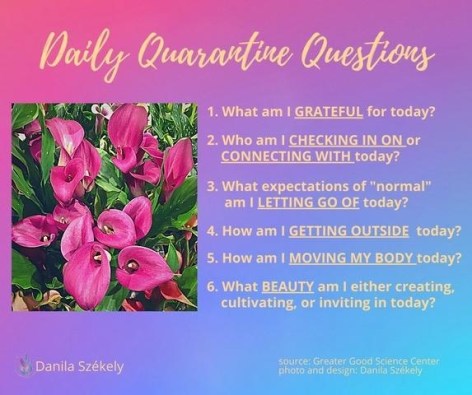
This lovely graphic was sent to me by a dear friend, Danila Székely, who is also a life-coach:
Source: Greater Good Science Center; photo & design: Danila Székely
Another good friend just today told me about Yo-Yo Ma’s mission to share Songs of Comfort — beautiful music from him and other musicians shared from their homes to ours. Among other places, you can find out more about this on Silkroad Home Sessions. This is a wonderful way to spend some time freed up by moving away from the news.
If you live in the northern hemisphere in a temperate zone, Spring is here. This is true even if you’re in the middle of a blizzard (which I hope you’re not). Where I grew up, March snow is common, and so was the sight of crocuses blooming in the snow, bravely and beautifully. They not only blossomed – they survived. We can be like the crocuses – or at least we can see and be heartened by their beautiful resilience.
Spring is every bit a real and true as Covid-19. And Spring is the triumph of Earth and Life over an adversary far more ancient than this virus. That is worth being mindful of, and worth celebrating.
Wishing you all light and comfort in these uncharted times.
I’m very pleased to continue my series of Running WildAnthology of Stories author interviews with Jenn Powers. Her story, “A Friend’s Text,” captured my senses with its vivid imagery and my emotions with the plight of the main character.
Welcome, Jenn!
Gemma: Please give us a taste of what your story is about.
Jenn: My short story, “A Friend’s Text,” is about a woman who has an epiphany that helps lead her out of an unhealthy love affair with a married millionaire.
Gemma: Do you remember what the seed for this story was?
Jenn: Yes, I do. I fictionalized a similar relationship I had fallen into myself. During that relationship, I always felt like I was betraying my true self—the core of who I am. Once I decided to do the right thing and end the relationship, it was completely life-altering and empowering, even though the pain was immense. I think this scenario is, unfortunately, too common. I hope my story will inspire others to find it within themselves to do the right thing if they’re in an unhealthy relationship, which comes in many forms.
Gemma: That is truly a powerful mission, and I can see your story being a positive catalyst. Can you tell us a little about your writing history?
Jenn: I started journaling when I was 15 years old. It was a way for me to soothe my emotions since I was quite lonely and I didn’t have many people I could trust or open up to. Journaling turned into a survival mechanism. Being able to spill out my troubles onto the blank page became (and still is) very therapeutic.
Gemma: Writing can be such a healing process, and to be able to share that is a gift. I found out from your website that you’re an artist as well as a writer. Does art have a therapeutic effect for you like writing does?
Jenn: Absolutely. Whenever I’m being creative or out in nature, I lose myself. It’s very in-the-moment mindfulness. I’ve always struggled with anxiety, even as a child, and so, early on I found ways to tend to that. I figured out how to self-soothe with art and nature. I journaled throughout my teens and the writing sort of bloomed in different directions from there. I can say the same thing regarding art. Painting, drawing, photography. One feeds the other. And both feed me. It’s symbiotic.
Eventually, I played around with creative writing, such as flash fiction and short stories. By my 30s, I started to pursue it seriously and I got my first short story publication in 2012.
Gemma: I’d like to hear more about that.
Jenn: My first publication was in The MacGuffin in 2012, a short story about domestic violence. It’s titled “Some of Us.” I’m proud of this piece because it’s important to keep violence against women (and men) at the forefront.
Gemma: That’s truly something to be proud of, and a vital message. Can you tell a little more about your writing history?
Jenn: I kept at the craft, sporadically, while living life and working a multitude of jobs. Around 30 to 33 years old, I took writing more seriously. I wrote several days per week, and now, about eight years later, I have around 70 publications in literary journals. (Half art, half writing.)
Gemma: Very cool to have so many stories published in so short a period! How has your writing changed over time?
Jenn: I’m continuously growing as a writer. It’s a constant learning process, and, for me, there’s no end point. I improve every year. And, like anything, the more you work at something, the better you get at it.
Gemma: What do you like best to write?
Jenn: Drama, thriller, mystery.
Gemma: What’s the biggest challenge for you to write?
Jenn: I tried writing in other genres, like romance. But it doesn’t work for me. I write about the dark stuff. I’ve experienced some crazy situations. I’ve been a victim many times over, but I’d rather call myself a survivor. As a survivor, I empower myself through writing, and I believe my past experiences have molded my style and preferences.
Gemma: And good stories, like “A Friend’s Text,” can empower readers in turn. When you get an idea for a story, what comes to mind first, the plot or the characters? Or does it vary from story to story?
Jenn: It varies from story to story. It might even be a feeling, a song, a landscape or place that makes me feel something. When I sense that dip of inspiration, I stop to explore where it’s coming from. Does it remind me of something or someone? Does it reconnect me with a lost emotion? My ideas come from the strangest places and my inspiration is super-fickle. I’ll sit there frustrated for hours, take a break and go for a walk or run, and an idea will hit me. Boom! Just like that. Easy-peasy. Taking the pressure off can stimulate creativity. And creativity needs to be organic, natural, flowing.
Gemma: I often get some of my best ideas walking, too. If nothing else, it can open up the channel and let the creativity flow, as you say. I read on your website that you have a fondness for botany and geology as well as music. I have a love of biology and botany that’s stuck with me since junior high, so that resonates with me! Do you have stories that particularly reflect botany, geology, or music?
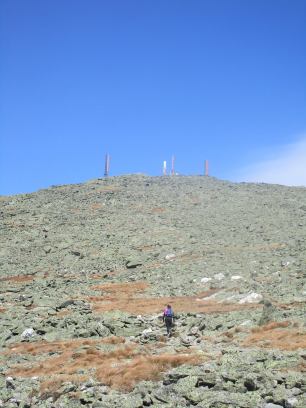
Jenn: A driving force in my life is exploring nature, whether that comes in the form of hiking up Mt. Washington, driving solo cross country, or studying a birch tree throughout the seasons. Inevitably, this passion and interest has infused my life and work as a writer and visual artist.
Jenn Climbing Mt Washington
Jenn: Growing up as an only child without too many close friends, I always found solace in nature. Early on, I’d collect pinecones and chips of Mica and bluets. I’d explore the forests and swamps near my neighborhood. I’d be outdoors as much as possible. I’d also draw, paint, and write since I was alone a lot. In school, ecology and biology classes felt very natural to study. It came easy, even though I majored in English and creative writing in college.
About seven years ago, I started studying botany. I love exploring the woods with a field guide to identify the plants, flowers, and trees. Mostly the New England area, and specifically, Connecticut. I like to observe how nature changes throughout the seasons. It’s like getting to know a friend. I focus on the anatomy, ecology, and taxonomy. It’s fun to nail down genus and species. It’s this entire plant kingdom that’s keeping us alive, and vice versa. A true symbiotic relationship. It amazes me how every little thing is connected. I just started getting into geology too—rocks and minerals of a particular location and the geological history of that location. For example, the plethora of rock walls crisscrossing New England.
So, as you see, this passion I have for the outdoors has formed a large part of who I am today as an adult, and, inevitably, it shows up in my work. I’ve used nature (or setting) as a character itself in many of my short stories. It’s a tool used to set the tone or mood. It can be used symbolically, metaphorically. It can literally be an extension of the protagonist or antagonist, or even a minor character. Mix that up with being a fan of nature writers, like Emerson, Thoreau, Muir, Dillard, Ackerman, and certain literary periods and movements, like the Romantics, Gothic, the Transcendentalists, the Beat Poets, and contemporary mysteries and thrillers, and that’s my writer-artist brain on fire. It’s nostalgia, melancholy, and the darker side of nature rolled into one.
Since I started writing a mystery-thriller in 2016, I’ve infused my novel with a lot of botany, and I believe it adds something truly special. I believe people want to feel that connection to earth, which is so easily lost in today’s fast-paced, superficial, materialistic society. They want real. They want to feel something that’s good for their soul. I also believe the more you know about a specific region, the better. You may not use all of that collected information but knowledge is never a waste.
Gemma: I totally agree – knowledge has worth for its own sake, and you never know what connections that will spark in your brain. You mentioned several authors before – what authors did you love most growing up? And what other authors have influenced your writing?
Jenn: Ironically, I didn’t read a lot as a kid. I loved being read to in school. I remember falling in love with the work by Shel Silverstein and Dr. Seuss. I liked the Sweet Valley High series too. I liked The Catcher in the Rye, The Outsiders, and Poe and Bram Stoker. But it wasn’t until college that my obsession with books began. As an adult, I’ve been most influenced by legends like Joyce Carol Oates, Flannery O’Connor, Truman Capote, John Cheever, Joan Didion, and Mark Twain. As for more recent authors, I read Gillian Flynn, Shari Lapena, Jennifer McMahon, Delia Owens, Janet Fitch, Karin Slaughter, A.J. Finn. I could go on and on.
Gemma: It’s a wonderful thing to have so many authors to love, and it makes it hard to name just a few! What are you reading right now?
Jenn: I’m reading several books right now. For fiction, I’m reading Burntown by Jennifer McMahon and Paint It Black by Janet Fitch. For nonfiction, I’m reading Kaufman’s Field Guide to Nature of New England, and, National Audubon Society Field Guide to North American Wildflowers (Eastern).
Gemma: I love reading field guides, too, and I actually use them sometimes even though I write fantasy! They really can help ground you in a place by learning about the other living things around you. Is there a place that you’ve lived that most influences your writing?
Jenn: Old New England. The snowy, gray winters. The green hills and rock walls. The homesteads and chimney smoke.
Gemma: Where I live in Pennsylvania has a lot in common, and the green hills, rock walls and centuries-old buildings are inspiring to me, too. Tell us a bit about what you are working on now.
Jenn: I’m writing a mystery thriller around 80-90K words. I’m in the rewriting phase. I should be done by spring and will be searching for agent representation. I’m also working on a collection of paintings/drawings based on the hometown in my novel. Here’s an example of where my passions overlap each other. Science meets art. Left brain meets right. I’m in love with nature, but I’m also in love with art. The fictional hometown in my novel is named Rockwall Springs, which is loosely based off Tolland, Connecticut, my own hometown.
Gemma: That is so cool! Will your artwork about the town be viewable by your readers?
Jenn: Yes, these photos and paintings will be available for anyone interested. I’ve had several photos of Rockwall Springs published in various literary journals. For example, three photographs were published in The Sandy River Review (September 2018) and one photo was published in Blue Mesa Review (Issue 39, 2019).
Gemma: What do you plan to work in next?
Jenn: As soon as I begin the querying process for this book, I will begin another mystery thriller. I would like to write them in succession. I’m also working on short prose, poetry, and art.
Gemma: It’s very impressive that you work on multiple projects at once. Will the next mystery-thriller be a sequel to the one you’re working on now, or are they stand-alones?
Jenn: That’s a good question. I’m open to either option. As of right now, it’s a stand-alone novel. But, I could definitely create more novels using the same characters and settings. If not, I’d like to write a mystery-thriller every two years or so. Once I find an agent and get a book deal, that’s my goal. I want to stay productive.
Gemma: How did you find out about this anthology?
Jenn: Honestly, I don’t remember. I am a subscriber to several outlets offering opportunities for creative writers. It might’ve been via Submittable. I am thrilled to have found this west coast press.






 Gemma L. Brook