Book Reviews: Stamped and The Lost Tribes

Stamped: Racism, Antiracism, and You  by Jason Reynolds and Ibram X. Kendi

Based on (a Remix of) Stamped from the Beginning by Ibram X. Kendi

I expected this book to be well-written, thought-provoking, and engaging. And it truly was, starting with the Introduction by Ibram X. Kendi (how often are Introductions themselves absorbing?) It was also painstakingly researched by Dr. Kendi, (a professor of history and international relations), as revealed in the twenty pages of source notes.

What I didn’t expect was that it would be so hard to put down. But that’s how Jason Reynolds made his remix of Kendi’s book. Once I started reading, I didn’t want to stop. Even though I am decades away from Jason Reynolds’ target audience, I had to keep turning the pages.

The book traces the history of racism over six hundred years, from its roots and through its introduction to newly-colonized America, up to the present day. But it is not, as Reynolds emphasizes, a history book. It is a book that contains history – a history that is most often troubled and troubling.

It was hard to read about some people I admired from the past. Jason Reynolds paints nuanced portraits that shows how complex these people were, and how they changed and evolved over time. It was harder still to read about people from my lifetime – some of whom I voted for. This book is eye-opening and revealing, including about some of my own unconscious assumptions. Because, as Jason says, this book is about all of us.

This is a vital, riveting book. I read it months ago and have wanted to review it ever since, but, well, it’s been a fraught year. Also, I was daunted by the knowledge that I can’t begin to do the book justice. Read it and let it speak for itself. I highly recommend it. If you don’t think a Young Adult book is for you, consider Stamped from the Beginning by Ibram X. Kendi. It may be the next book I read on this subject.

These two authors held a very interesting discussion about their book with some high school students you can read about and listen to.

As  Christine Taylor-Butler wrote in June of last year, “I’m a parent, author, and a former college interviewer. Please hear me – in this time of stress people want to “flood” their kids with books about racism. Please provide 20 joyful books for every one book on racism. They also need to know POC kids are like every other kid.”

I began to take her advice for myself, and read her book The Lost Tribes. It fulfills her suggestion perfectly! Five friends from diverse backgrounds have adventures while just being kids. And what adventures! They’re given a high-tech computer puzzle to solve, with virtual reality that takes them to Egypt, Easter Island, Peru, and sub-Saharan Africa among other far-off places. The computer simulations become eerily realistic. And when their parents disappear, they have to undertake a dangerous journey. The kids discover that nothing is what they thought. The truth is amazing and empowering.

I can’t really capture the story, especially without giving too much away. Science and history are woven throughout in fun and interesting ways. There are puzzles and codes the kids have to solve, and readers can try out, too. And the website has a couple of fun challenges with more to come (delayed by the pandemic). But you can watch the cool trailer, meet the kids, and get introduced to their parents.

Kirkus Reviews calls it “Well-written and well-paced: a promising start to what should be an exciting and unusual sci-fi series.” See the full review here.

I recommend this book if you’re looking for a good story for kids who like adventure – or if you’re such a kid at heart yourself.

The next book, Safe Harbor, is out, and a third is expected later this year. I’m looking forward to continuing the adventure!

Happy Juneteenth!

Happy News for Enola Holmes Fans!

I’m emerging from my deep Cave of Projects to sing out some good news. I just found out this morning that there’s more Enola Holmes on the way! I’m so excited, I hardly know what to announce first.

Ok, here goes: there’s going to be a second Enola movie on Netflix!

I really enjoyed the first one, so much so I’ve watched it twice and look forward to watching it again for a future review I hope to post.

Even better news: there’s going to be a NEW Enola Holmes book! Enola Holmes and the Black Barouche.

As much as I enjoyed the movie – the books are some of my favorite books ever. They are mysteries with clever, riveting plots, great atmosphere, codes the readers can work on, and the deeply appealing Enola herself.

I thought the series was complete, with the very satisfying (and more than a little moving) The Case of the Gypsy Goodbye. So my surprise at another book is exceeded only by my delight.

And there’s more! A new short story: Enola Holmes and the Boy in Buttons. That particular boy is a lot of fun, so I can’t wait to get the e-book.

On top of all this, last weekend I had the great pleasure to attend an online workshop with Nancy Springer as part of the online Pennwriters Conference. She was such fun! And had so much good advice for writing. I intend to share some highlights of the conference and what Nancy had to say.

Meanwhile, I have seven projects I’m working on, only one of which is my fantasy novel in progress, so it may be a while before I emerge. Back into my Cave of Projects! (Ok, it’s sunlit and infused with fresh spring air, but still – I’m trying to work on several of these things at once, so it’s a little hectic in here…)

In the meantime if you like a good Victorian mystery, read the Enola Holmes books!

Mid-Winter Gift Ideas

Someone’s wise tweet – I think it may have been Nicole Valentine’s – commended a plan to buy all Christmas gifts from bookstores and museum shops. I love this idea for supporting great places hard-hit by the pandemic.

I have hopefully dogeared a museum shop catalog with a desire of my own. As for gifts to give – books are always top of my list, and I’ve been collecting a small hoard all year. Which is a good thing, because shopping is not as easy or as safe as last year. It’s very fortunate indeed that two of my local bookstores offer curbside delivery. You, too, can give a gift to your community and order books from your local bookstore if you have one, and stay safely at home while you do it. They may also be able to send them for you.*

Here are some books I am going to give this year (shhh, no telling).

For a science fiction and comic book fan: Ray Bradbury’s The Martian Chronicles: The Authorized Adaptation, which I was lucky enough to find at my local indie bookshop (they don’t have it in stock now, but it can be ordered from Barnes and Noble).

For a history/nonfiction buff, who, after reading on my blog about the Winchester Mystery House, was inspired to dig deeper: Captive of the Labyrinth: Sarah L. Winchester, Heiress to the Rifle Fortune by Mary Jo Ignoffo.

For a young adult horror fan, The Screaming Staircase (Lockwood & Co. Series #1) by Jonathan Stroud, because this book gave me great chills and I don’t even really love horror.

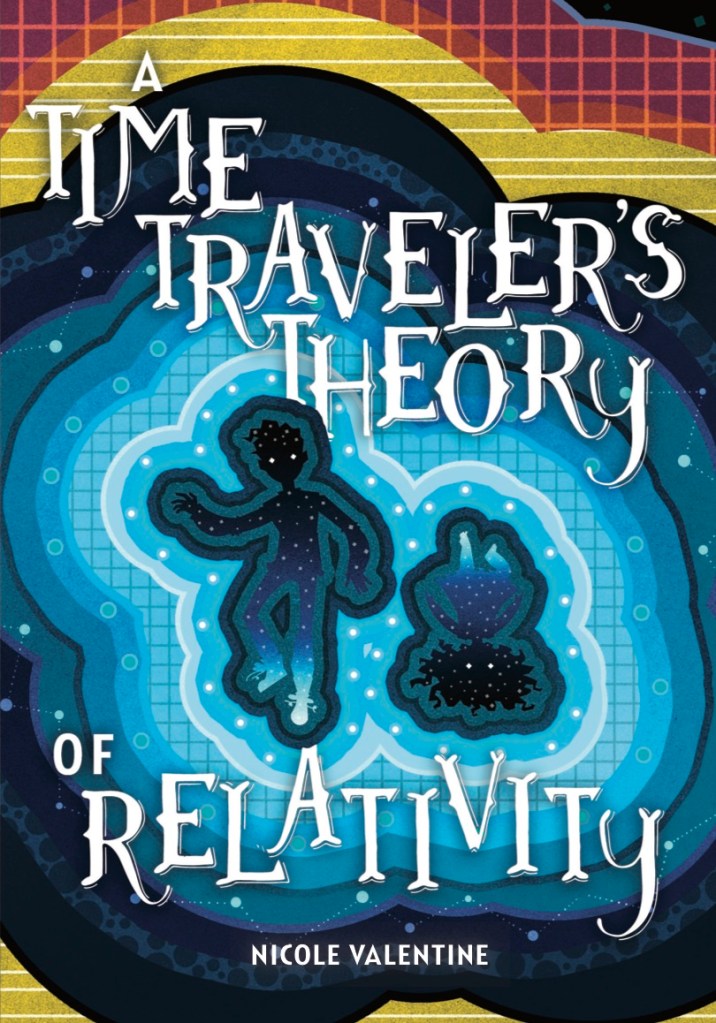
For a middle-grader with a big heart, a middle-grade book with great heart:  A Time Traveler’s Theory of Relativity by Nicole Valentine. This is another book I read and loved, though I am well out of the focus audience.

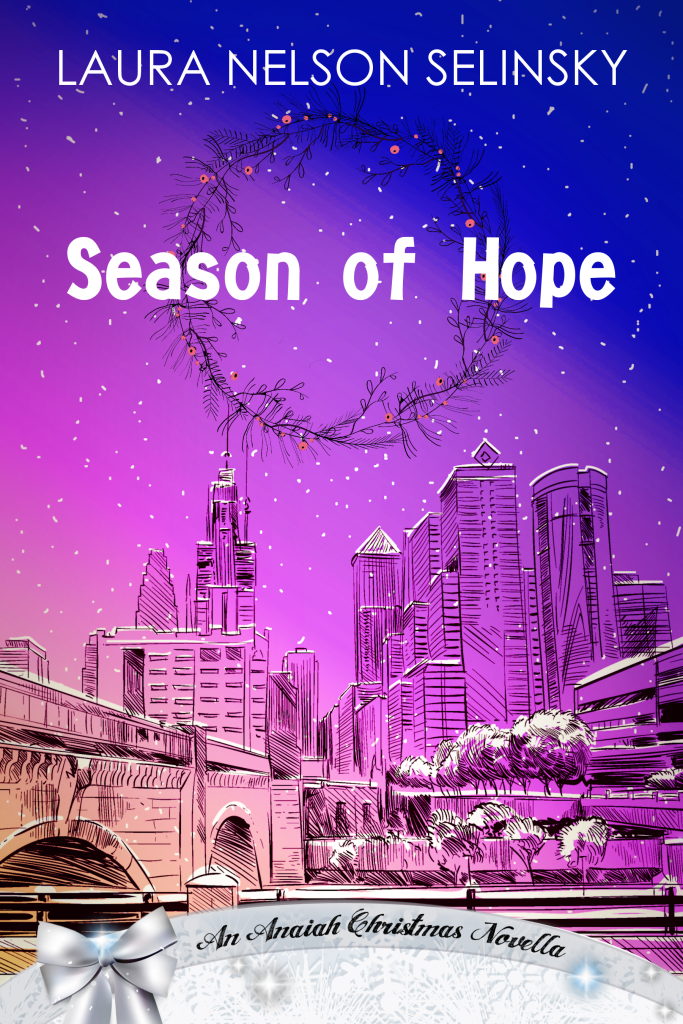
And for a dear aunt, a warm-hearted Christmas romance, Season of Hope by Laura Nelson Selinsky.

cover art for Season of Hope novella

For more ideas of books to give, you can see my blog on this from last year.

Another suggestion for gift ideas: are there local artists and artisans who might have websites you could order gifts from?

How about a gift for yourself: a short collection of fine tales to take you back to the old West? My writing friend VT Dorchester has a great tale online in the December issue of Frontier Tales. I’ve read a number of these, and they are fine stories. So far, I’m particularly fond of VT’s, “Horseshoe Nail Stew”, a clever and deepened retelling of the Stone Soup folktale. I’m looking forward to taking a small break and reading more stories, then choosing and voting for my favorite. Well done, VT!

Whatever holidays you observe, may you find the light, and celebrate and share it.

*Yes, you could probably get most if not all of these books at Amazon, but Amazon has done extremely well during the pandemic. Why not support bookstores, museums, and artisans who have been hit hard?

Book Review: Circe by Madeline Miller

cover art of Circe by Madeline Miller
Cover Design: Will Staehle*

I’ve loved Greek Mythology for as long as I can remember. One of my older sisters told me myths as bedtime stories (I still remember first hearing the tale of Baucis and Philemon from her). My family had a copy of Edith Hamilton’s Mythology tattered from much reading. And mythology has influenced my writing, including the novel I’m working on now. So I was quite intrigued when I saw Madeline Miller’s Circe ** at my local indie bookshop. When I read the first page, though, somehow I wasn’t pulled in to read more. I’m not sure why – it may be that her vision of the Greek gods and Titans wasn’t mine. But when the pandemic hit, I wanted to support my local bookstore, and so I ordered it from them – it was the first book, but not the last, that I got via “curbside delivery.”

This time when I opened that first page, I was hooked. I think this speaks of the power of Miller’s writing, and also the power of commitment – that book was now mine; I was literally, though in a small way, invested in it. Whatever the reason, I was pulled in and didn’t want to stop (it happened again, when I glanced inside to write this review).

Her vision of the Greek divinities is indeed different from mine, which has formed over decades. But her portrayal is vivid, visceral, and immediate – you feel in their presence. The Titans and gods in her story are so very human – sometimes petty and squabbling. But they can also be chilling, even terrifying.

From the time I read of Circe as a kid (in Edith Hamilton), I always felt some sympathy for her. After all, the way she treated Odysseus’ sailors felt like poetic justice. Madeline Miller has made Circe deeply sympathetic – starting as a child hungering for her father’s attention and basking in his literal radiance. (He is Helios, Titan of the sun, and his gaze can warm – or scorch.)

I loved how the writer wove so very many beings from mythology into the story. It was startling to realize Circe’s brother was Medea’s father. And how had I forgotten, or not known, that Pasiphaë, mother of the Minotaur, was Circe’s sister? I’d always thought of bull-besotted Pasiphaë as cursed and somewhat pitiful. The author has transformed her into something – someone – quite different. With Pasiphaë comes the tale of Daedalus, the Labyrinth, and the Minotaur – no longer distant and misty, but close, vivid, and as frightening as a bull-headed monster should be.

Prometheus also appears; it’s one of my very few regrets in the book that we don’t see or hear of him again. And of course, Odysseus plays a major role. But his appearance is not the end of Circe’s story. In some ways, though he comes in late in the book, he marks a new beginning for Circe.

I highly recommend the novel, not only because of its Greek Mythology, but because it is a novel of rich story and characters, centered on a vibrant female narrator.

When I finished Circe, I wasn’t quite ready to leave the world of mythology. I pulled out an old book of mine that seemed promising – The World of Odysseus by M.I. Finley.

Cover art of World of Odysseus
Cover: Kylix by Exekias*

It’s a slim, dense, scholarly book that uses the Iliad and Odyssey as sociological documents to learn about the environment Odysseus lived in (which the author believes was Iron Age Greece). It feels dated, which is no shame to the book – it was first published in the 1950s and revised in the 1970s, so no wonder there. But it is jarring, even repellant, when he refers to some modern-day non-industrial cultures as “primitive” or “savage” – even if only in quoting the titles of works he refers to. He does have some interesting insights into life of very ancient Greece. But I did not enjoy reading it enough to whole-heartedly recommend it.

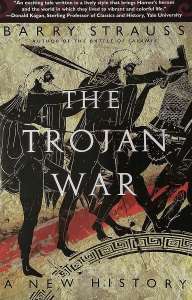
What I can whole-heartedly recommend is The Trojan War – A New History by Barry Strauss.

Cover of Barry Strauss' The Trojan War
Cover design: Honi Werner*

His work draws not only on much more recent archaeology, but also on other sources including Hittite and Egyptian texts, to make a compelling case that the Trojan War was not only real, but occurred in the Bronze Age (earlier than the Iron Age, and in the general period Homer said it did). Even better, he paints scenes as colorful and dramatic as any novel, then expands on them with what he’s gleaned from other sources, while treating the characters of the Iliad and Odyssey as real people with real, Bronze-age motives. He not only treats Homer with respect, but helps make that world come vividly to life. His book also includes a very helpful timeline (for those of us who need help keeping the Bronze Age separate from the Iron Age and from Homer’s time), and a series of maps with ever-increasing detail, which give the reader a firm footing on where and when the Trojan War took place.

I’m sorry to see that Barry Strauss’ book may not be available in print, though it does appear to be available as an e-book, and I recommend it as a good read.

For more about the archaeology of the Trojan War, PBS has an excellent show: Secrets of the Dead: The Real Trojan Horse; Barry Strauss is one of the experts who speaks. And the magazine Archaeology has online an interactive map of the many layers of Ancient Troy, with context: Uncovering Troy

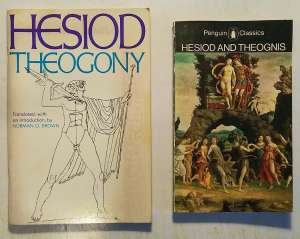
The book Circe is about so much more than the Trojan War and Odysseus, though. It begins when the world is young and the wounds of the Titans’ war with the Olympians are still raw. Hesiod’s Theogony tells of that war and of the birth of the world and all its divine beings. I read two translations of the Theogony, one by Norman O. Brown and one by Dorothea Wender; they returned me to the world of myth and wonder. And there, near the end, Circe is mentioned, bringing me back full circle.

Covers of Hesiod's Theogony, 2 translations
Right cover: Detail of Parnassus by Andrea Mantegna*

If I were to do it over, I’d skip The World of Odysseus and read Barry Strauss’ The Trojan War instead. And I’m glad I reread the Theogony. But it’s Madeline Miller’s Circe which lingers with me. I look forward to reading it again someday.

*All book cover photos are of my copies. I could find no art credit for the left-hand Theogony.

**The word nerd in me was pleased and surprised to read that Circe’s name means Hawk. The masculine form, Circos (Kirkos in Greek) is a particular kind of hawk named for its circular flight. Circe, Madeline Miller’s novel says, was named for her golden eyes and piercing cry.


Book Review: The Hate U Give by Angie Thomas

A powerful, gripping, timely story.

When I saw Angie Thomas’ The Hate U Give in my local bookstore, I admit the title made me wary. But when my husband brought it home to read for himself, I glanced inside, and read. And read. And read. I could hardly put it down, and finished it in record time.

I’m pretty new to reviewing books, but the turmoil of our recent times moves me to try to do my best by this remarkable novel. I’m working from memory of when I read this perhaps a year ago. The details may be fuzzy, but the story has stuck with me.

16-year-old Starr is dragged to a party that she doesn’t want to go to. The one good thing is she reconnects with her childhood best friend, Khalil. When Khalil is driving Starr home, they’re pulled over by a policeman for no visible reason – and Khalil, unarmed, is shot and killed.

Starr is grief-stricken, her life and world turned upside down. Her friendships are stretched to breaking. Over time, everyone she cares most about is in danger. And Starr is faced with the dangerous decision of to speak out, or not.

Starr’s story is told with power, with surprising humor, and with love. The people in it are all so very real, flesh and blood human beings. I felt like I got to know Starr and her family, and that was a privilege. I cared deeply about them, and got swept up in what was happening to them, the harrowing choices they had to make.

My husband reads more nonfiction than fiction, but he, too, could barely put this book down. We saw the movie together. It differs from the book in a few significant ways, but author Angie Thomas was an executive producer, and that gives me some assurance that the changes had her permission. The ending may even be more powerful than the book’s.

Both the book and the movie have my highest recommendation. They are excellent in their own rights, and so very important, especially now. I really haven’t begun to do them justice; to do that, read and see them for yourselves.

Black lives matter. Black voices need to be heard. Black stories need to be told.

Publisher’s Weekly has made lists of antiracist fiction and nonfiction reading for adults. You can find the fiction list here, and the nonfiction list here.

For antiracist nonfiction for younger people, have a look at Stamped: Racism, Antiracism, and You by Jason Reynolds and Ibram X. Kendi. I have not yet read it, but an interview with the authors – and some high school students who read their book – make a very compelling case for it.

But as black author Shanna Miles said on twitter, “By all means pick up books about how to talk about racism but then you must pick up books about black kids being kids. If you don’t you teach your children that the natural state of being for black folks is suffering.” She links to some books on that twitter comment, and has made a Goodreads list as well.

Her feelings on this matter are echoed by Christine Taylor-Butler, a black kid lit author who said on twitter, “I’m a parent, author, and a former college interviewer. Please hear me – in this time of stress people want to ‘flood’ their kids with books about racism. Please provide 20 joyful books for every one book on racism. They also need to know POC kids are like every other kid.” She has written a blog about why diversity matters in science fiction and fantasy.

These authors opened my eyes to a new perspective. I’ve added their books to my reading list. I welcome more recommendations on these subjects in the comments.


Blog at WordPress.com.

Up ↑